
Long Ma
Co-Founder & CEO
What is Social Media Automation?
What is social media automation?
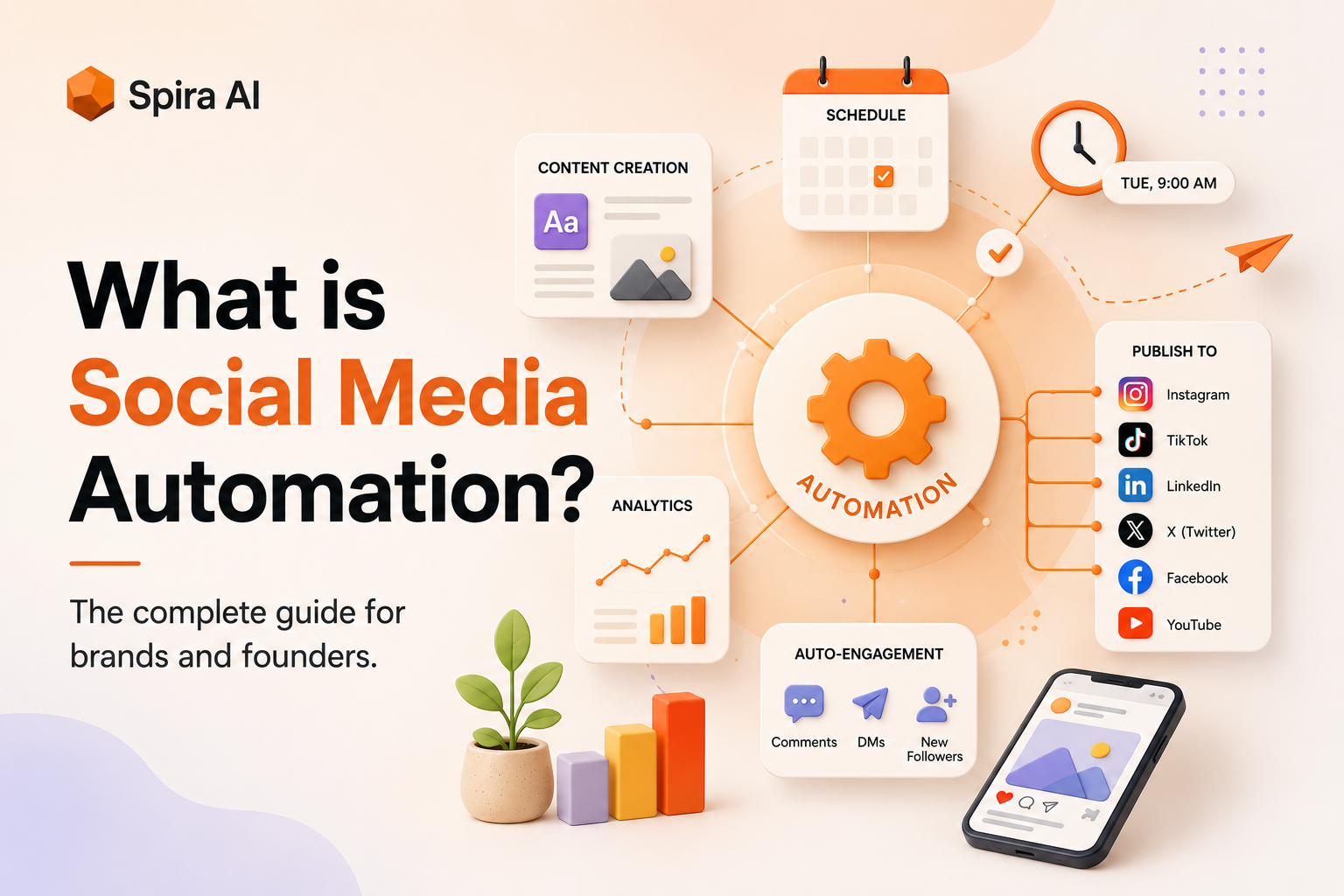
Social media automation is using software or technology to carry out repetitive and predictable tasks across platforms under one system. It's finding ways to automate different parts of the social media and content creation workflow.
You're running a brand or you're trying to be an influencer. You've heard from all your friends that consistency in posting is important. But, you don't have the creative bandwidth and time to push 10 different forms across 5+ channels. Even if you complete the task, how are you supposed to repeat it next week without burning out?
Should your brand or business do it?
Social media automation is a solution for many brands and companies to keep up with the marketing demand. Automation in social media can include:
- Generating templates and storyboards for your next content
- Updating your content calendar
- Pulling weekly performance data on your socials
- Creating engagement loops within specific channels (e.g., a user comments on IG, receives an automatic message)
- Understanding your reach and conversions to make recommendations on creative direction and targeting
Although we are in a new AI boom, social media automation has always existed and it is not AI only. The recent developments have only hastened this process, and we'll take a deep dive in this article to talk about the ins and outs of social media automation.
Is social media automation a bot? Agent? AI?
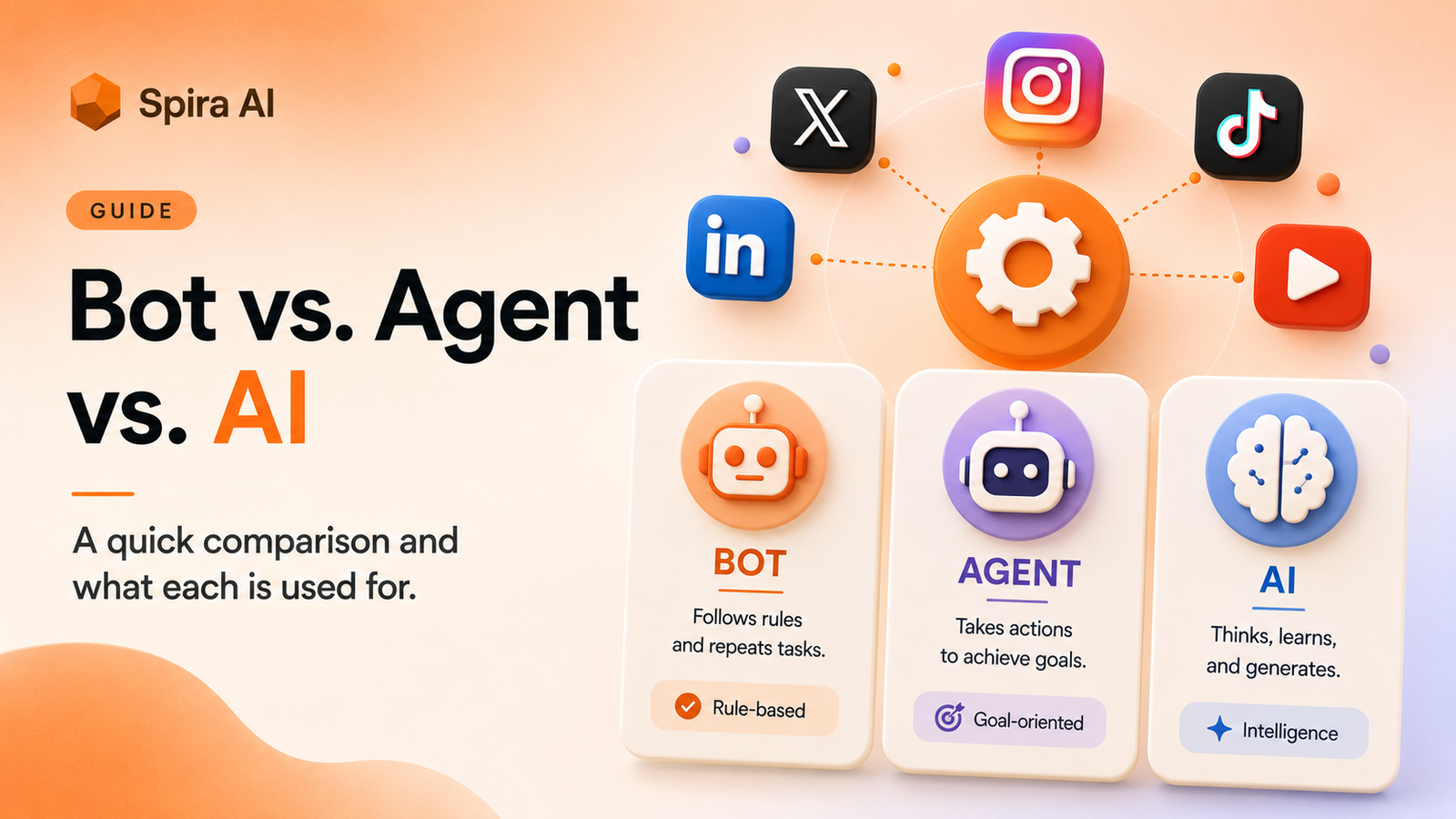
Social media automation is not one thing, or just a bot. It can be a bot, a workflow, an AI tool, or agents depending on the context, discretion, and use cases. But here's what each of it is used for:
| Term | What It Does | Example |
|---|---|---|
| Bot | Most basic form of social media automation. It follows preset rules and instructions. A bot follows this formula: when X happens, do Y. | A user comments "tree" on your Instagram post, the user automatically receives a DM. |
| Automation | A bigger system and can host the various tools: bots, schedulers, and more. A bot with it's rule-based triggers will handle one-interaction, but automation is the system of all these bots and how they're placed in sequence to manage the full workflow. | One bot schedules and posts content, another bot tracks data and gives high-level on what's happening, and the final bot will alert the team on when something important happens (that you set as a user). Connecting all these pieces together is what automation does. |
| Automation | Using intelligence and making recommendations based on what it's learning on the internet. Before, you set the rules with various platforms that have specific expertise to post content that can attract your ICP | Testing which content works best with what audience, and keep feeding on this pattern to target specifically your preferred customer segment. |
How long has social media automation existed for?
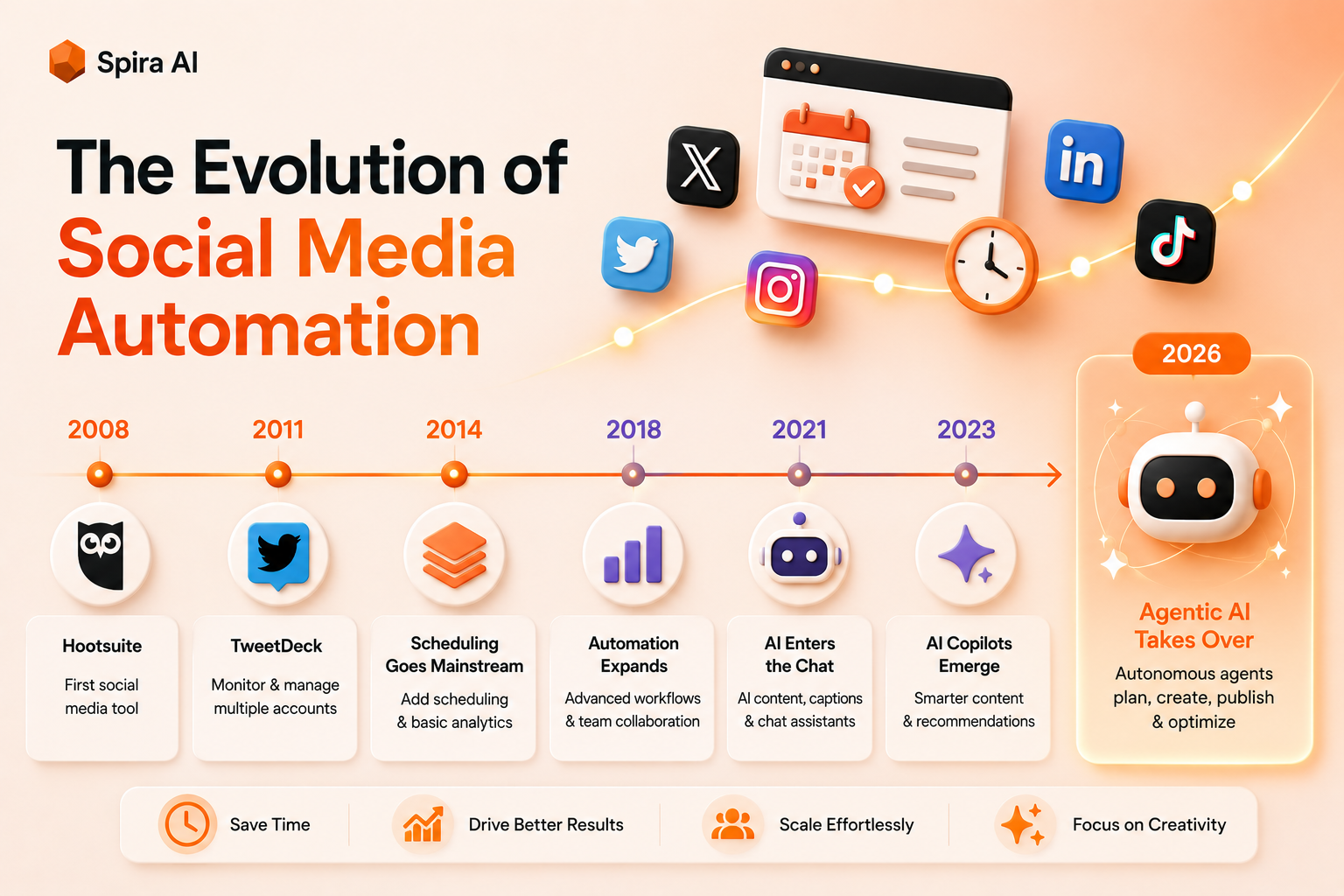
Social media automation existed for around 17+ years (using 2008 - Hootsuite as a starting point).
We've had various iterations of social media platforms come and go. 1997: Six Degrees. 2001: Friendster. 2002: LinkedIn. 2003: MySpace. And in 2004: Facebook, and eventually Meta.
Automation really kicked in 2008, when TweetDeck and Hootsuite started social media automation on scheduling posts and identifying the peak times where reach and engagement were highest.
Now we saw this service expand through other competitors entering such as Buffer and Sprout Social. They all tried to address a growing market of social media, and support businesses and individuals to work those channels efficiently, effectively, with returns.
Automation VS Scheduling
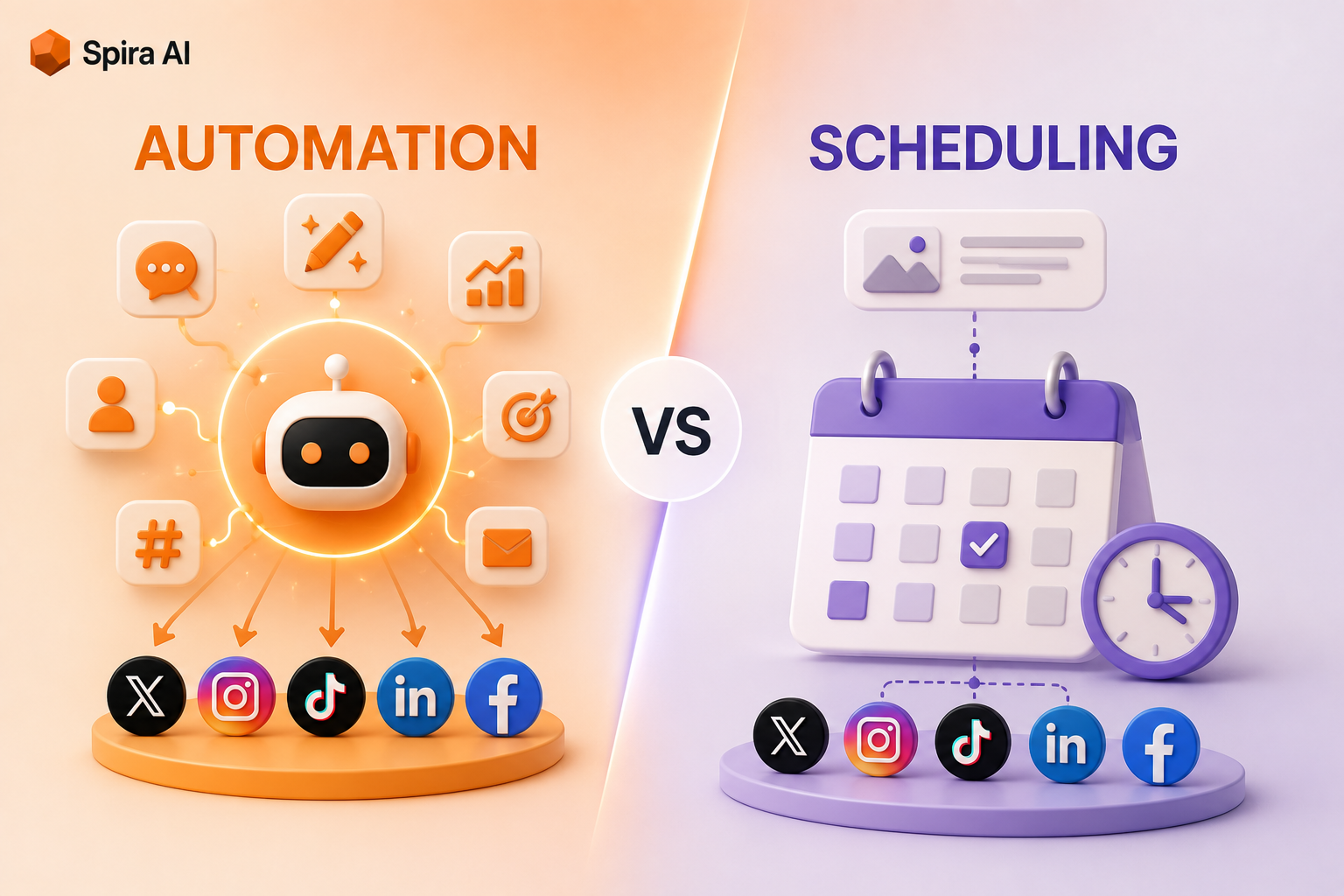
Before we dive deeper into social media automation, we have to parse out the difference between automation and scheduling. The two terms have been used interchangeably, but they each represent a different approach in marketing workflows.
| Scheduling | Automation | |
|---|---|---|
| Definition | Doing the work in advance and executing it later | Doing the pre-work once and letting the software repeat and execute based on rules you set |
| Human Input | Manual: you still create captions, upload images, and select the time to post | Minimal: focused on setting workflows and logic, not ongoing manual input |
| How it Works | Content is placed in a queue and published at a specific time | A trigger (e.g., a new blog post) automatically generates captions, image requirements, and publishes across channels |
| Rules | One rule: time-based | Multiple rules with different tools working in sync |
| Trigger Point | Time-based only | Event- or condition-based (e.g., a new file, a form submission, a published post) |
| Example | Writing a caption, uploading an image, and setting it to post at 9 AM on Tuesday | A new Microsoft Word blog post automatically generates its own captions, image requirements, and publishes on multiple channels |
What has social media automation done or actually do? What tasks can it accomplish?
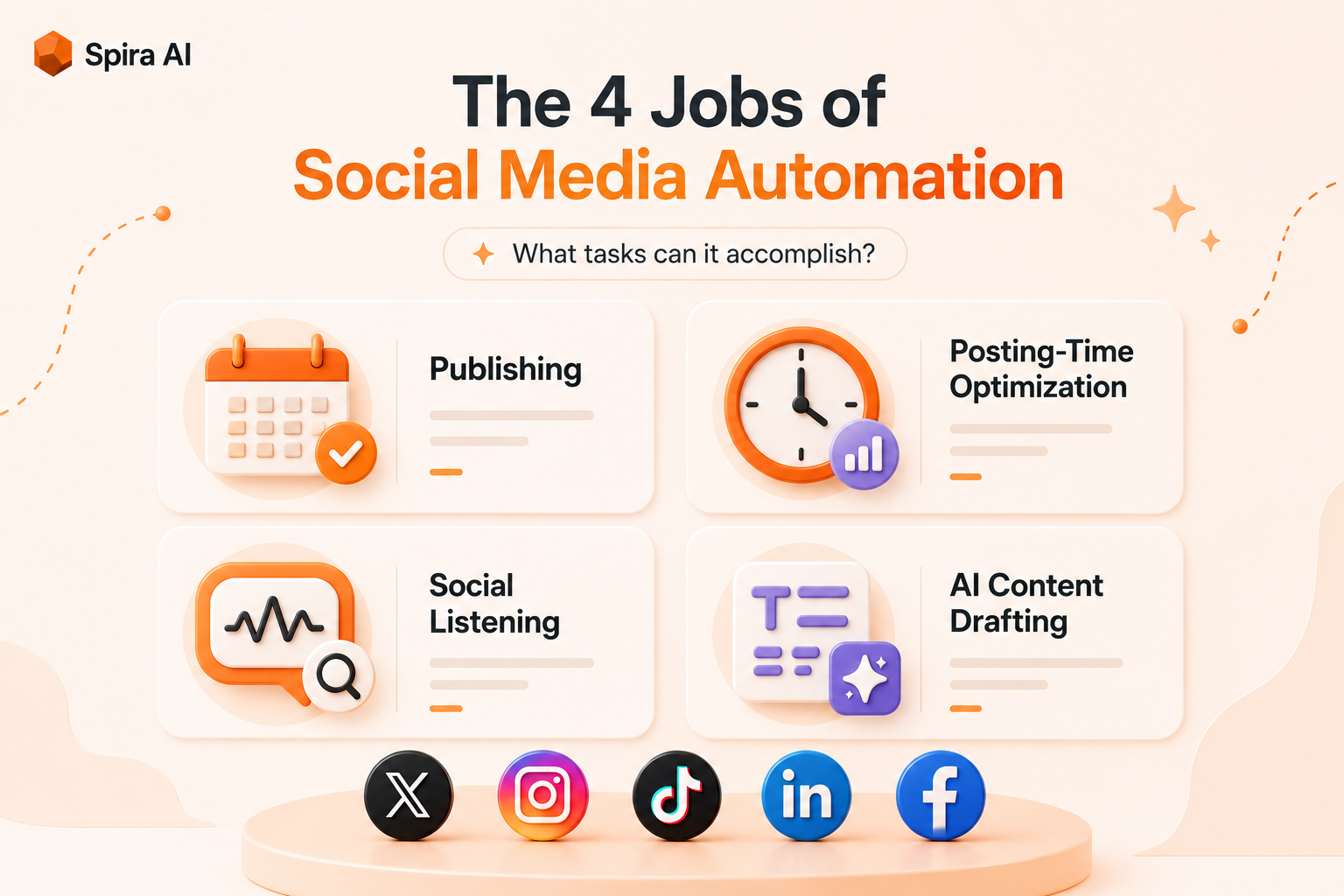
Since 17+ years of existence, social media automation has advanced rapidly and can do a myriad of tasks that would have taken months to complete in days. Here is a more detailed list of all the social media automation tools available at anyone's disposal, but here are the key components of four tools that have been critical towards the advancement of social media automation:
Scheduled & Cross-Platform Publishing
On X, LinkedIn, Instagram, TikTok, and more, all platforms now host "Scheduled Content", where users can upload and schedule their content in advance.
For a breakdown of what to use, see our guide to the top social media automation tools
Posting Time Optimization
Posting-time optimization and scheduled posts are the most important features that social media automation is documented on. Every brand, agency, creator, and marketer needs this tool as people use it daily to drive sign-ups. If social media automation were a SaaS product, scheduling and posting-time optimization drives the sign-ups while everything else in the pipeline drives retention and upsell.
Social Listening
Social listening is where enterprises find immense value with social media automation. It is a feature that turns a scheduling platform into a strategic intelligence platform. Brands will pay for social listening and alerts, because it helps them get closer to the key question they've wanted to ask a larger audience: What do people think about the brand? What are our competitors doing? Is there a crisis we need to be aware of?
Social listening is the process of tracking and analyzing social media conversations in various channels (blogs, forums, news) to find out what people are saying about brands and topics. Acquired at ~450M, Brandwatch, founded in 2007, is one of the leading platforms helping brands and marketers identify trends and actionable insights to shape business decisions. Some of these features include: monitoring social media (mentions, alerts, and responses across audience segments and conversations) and generating data dashboards to better understand the audience you're serving. Users using Brandwatch have used its analytics to report 158% growth in key client accounts. Other prominent platforms include Sprinklr.
AI Content Drafting
Ever since the launch of ChatGPT (2022), every marketer and brand agency has jumped on its features to add to their social media automation stack. Now many platforms and startups are joining in the race to provide AI copywriters so that marketers and brands can test and review numerous copies at scale and speed.
AI content drafting uses AI tools and models to help write copies in various languages that are tailored to the audience (specific keywords, tags, engagements). Following additional $180M funding, MoEngage is a self-learning generative AI engine that combines OpenAI capabilities with a brand's campaign performance to maximize engagement rates. By setting specific inputs around brand identity, voice, and audience segmentation, MoEngage's services generate messaging and campaigns that reflect brand identity.
What social media automation CANNOT do? What are the risks?
Although social media automation is a powerful tool, it doesn't solve everything. Relying on technology to run all of brand's social channels is a risk, and depending on different industries a huge liability (regulated industries such as healthcare/military or any political tension/sensitive cultural moments).
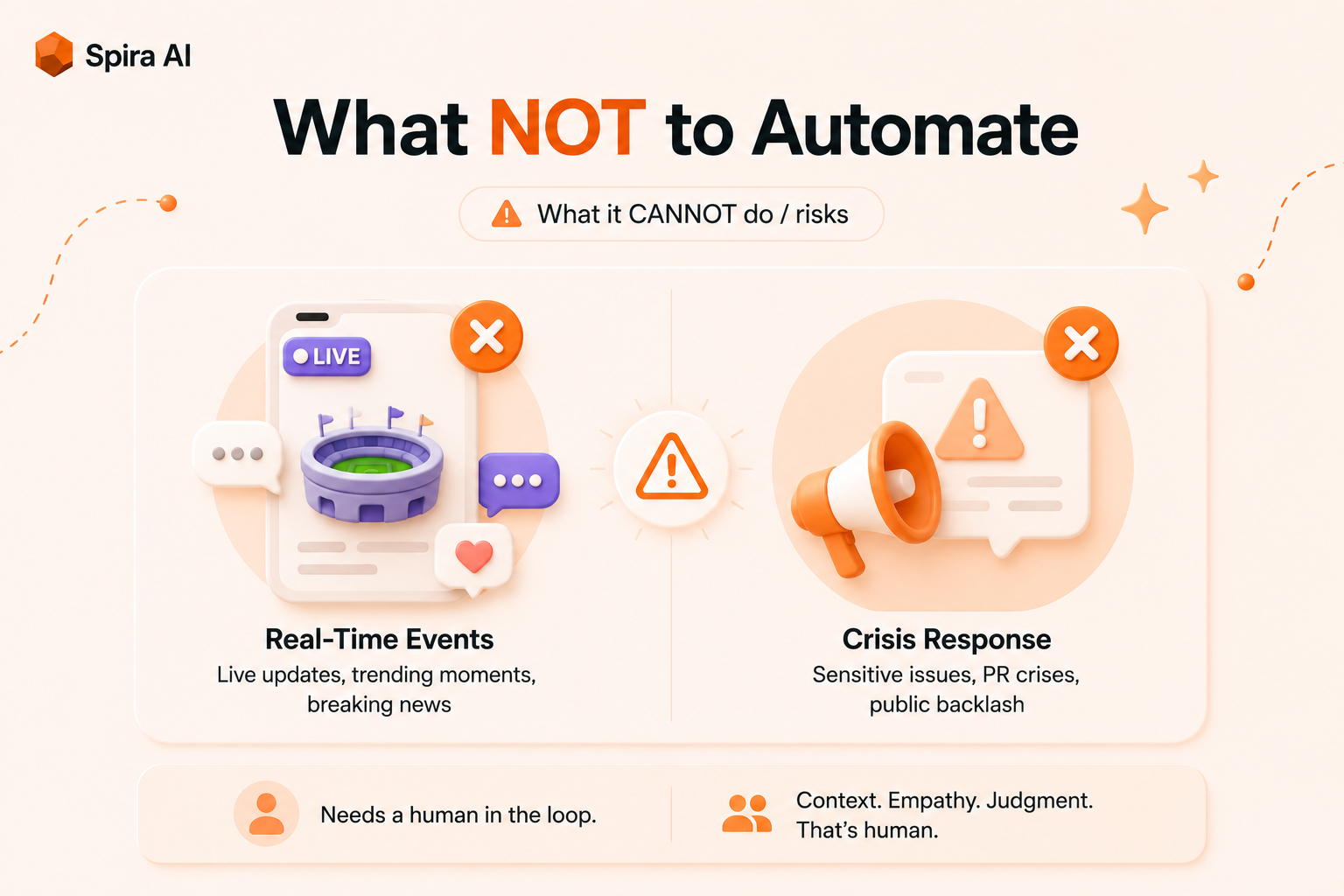
Here are some actions to never fully automate:
Cannot respond to real-time issues and needs
Social media automation is rule-triggered and executes on a specific schedule. Unless designated, these tools lack additional features to monitor news, cultural shifts, or any world emergencies that have happened. In 2012, Gap tweeted a promo during Hurricane Sandy (because of social media automation), a storm that displaced hundreds of thousands of people. Technology wasn't the issue, it was a failure of oversight. Human monitoring and touch are still key to the successful execution of social media automation.
Cannot manage crisis
Auto-reply workflows are beneficial when answering predictable, simple questions such as "How do I get a refund?" , "How do I log in?". Any simple FAQ can be easily addressed with social media automation. However, an auto-response does not de-escalate an angry customer or complaints. If anything, it may exacerbate the response and customer experience. Furthermore, certain inquiries or complaints must be adequately addressed by a licensed professional instead of an automated response. This is why crisis management is one of the last areas where every brand and marketer agrees that a human must be in the loop. Human intervention is essential to de-escalate situations and give the final touch that is required with empathy and authority.
How to get started with social media automation?
If you want to get started with social media automation, it might be too overwhelming with all the tools available. Moreover, it is important to discern which platforms track and measure across volume and performance. Since social media automations are rule-based and execute instructions, there is difficulty in catching up to how social media platforms track and evolve around engagement.Here is a step-by-step guide on how to get started on social media automation:
- Understand your workflow first. Audit and take a look.
- Find the right tool for your stage – see which ones seamlessly integrate with all platforms. Look into other marketers/KOLs on what they use
- Make sure to involve a human check on the process for automations.
- Automating your analytics first is nice. If you're nervous about automating content, start by automating your performance data and receiving weekly inbound trackers on your performance
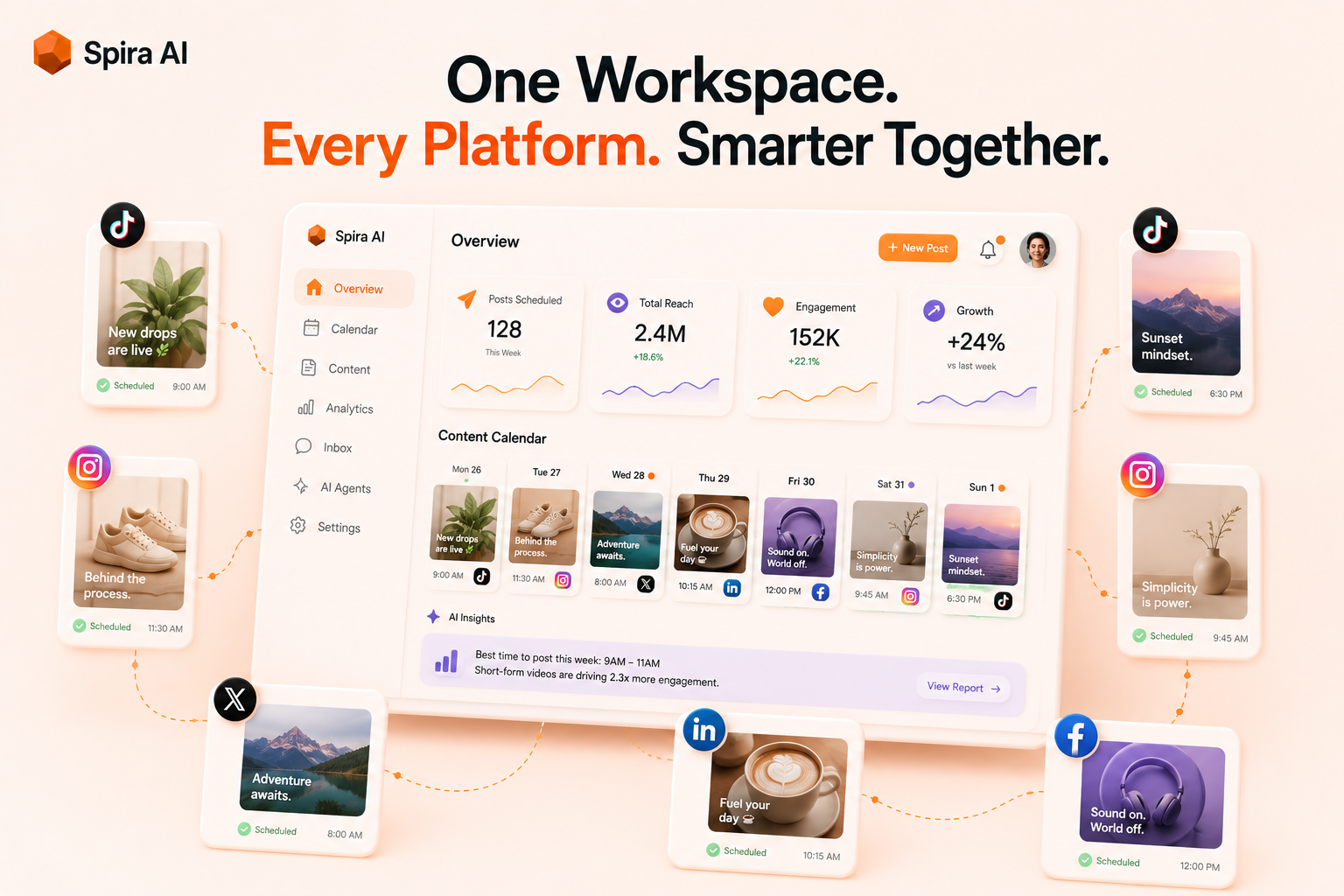
A tool to start with social media automation is Spira AI (Spira Product Page). It is a platform where every business gets its own AI workforce that runs its social accounts by detecting trends, auto-generating and publishing content, and growing the brand 24/7. Spira AI was built and reviewed by founders who have worked in Meta, Bytedance, Creatify to bring their expertise in the creative and content workflow into AI tools that work for brands and businesses.
AI and the future?
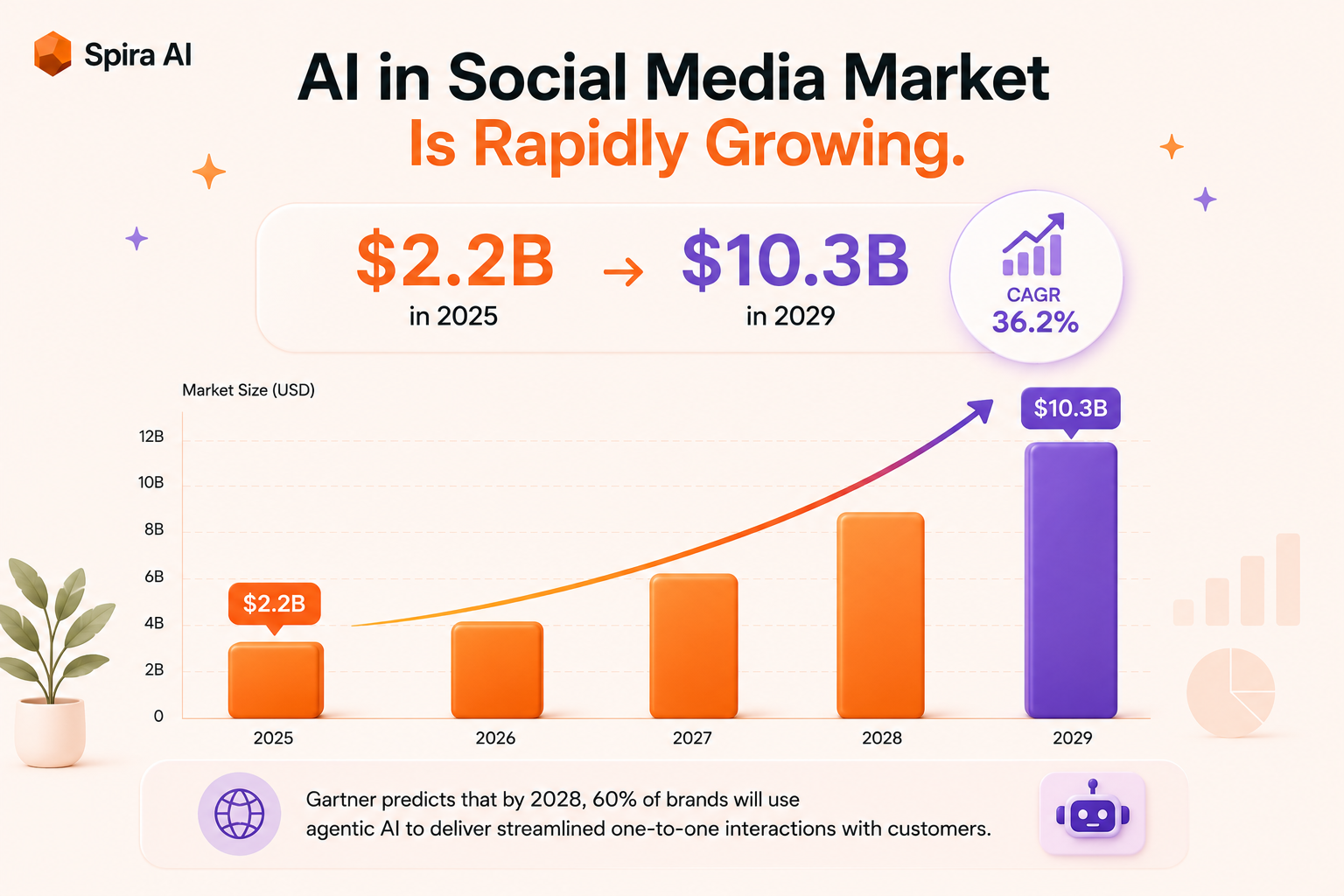
The global AI in social media market is projected to grow from $2.2B in 2025 to $10.3B by 2029 at a CAGR of 36.2%. Gartner predicts that by 2028, 60% of brands will use agentic AI to deliver streamlined one-to-one interactions with customers.
AI is here, and social media automation is currently being revamped thanks to rapid advancements in tech. From being more passive and rule-based, social media automation is moving towards more active and predictive behaviors. Currently, we are in the era of Agentic AI where software understands data, reasons for the outcomes, and takes action to achieve a goal without constant human supervision.
Before, if we had to give input and direction on different workflow components of social media automation, by 2026 we can simply give an AI agent a goal: increase TikTok engagement by 10% for this quarter among millennial users liking sports-tech in the US.
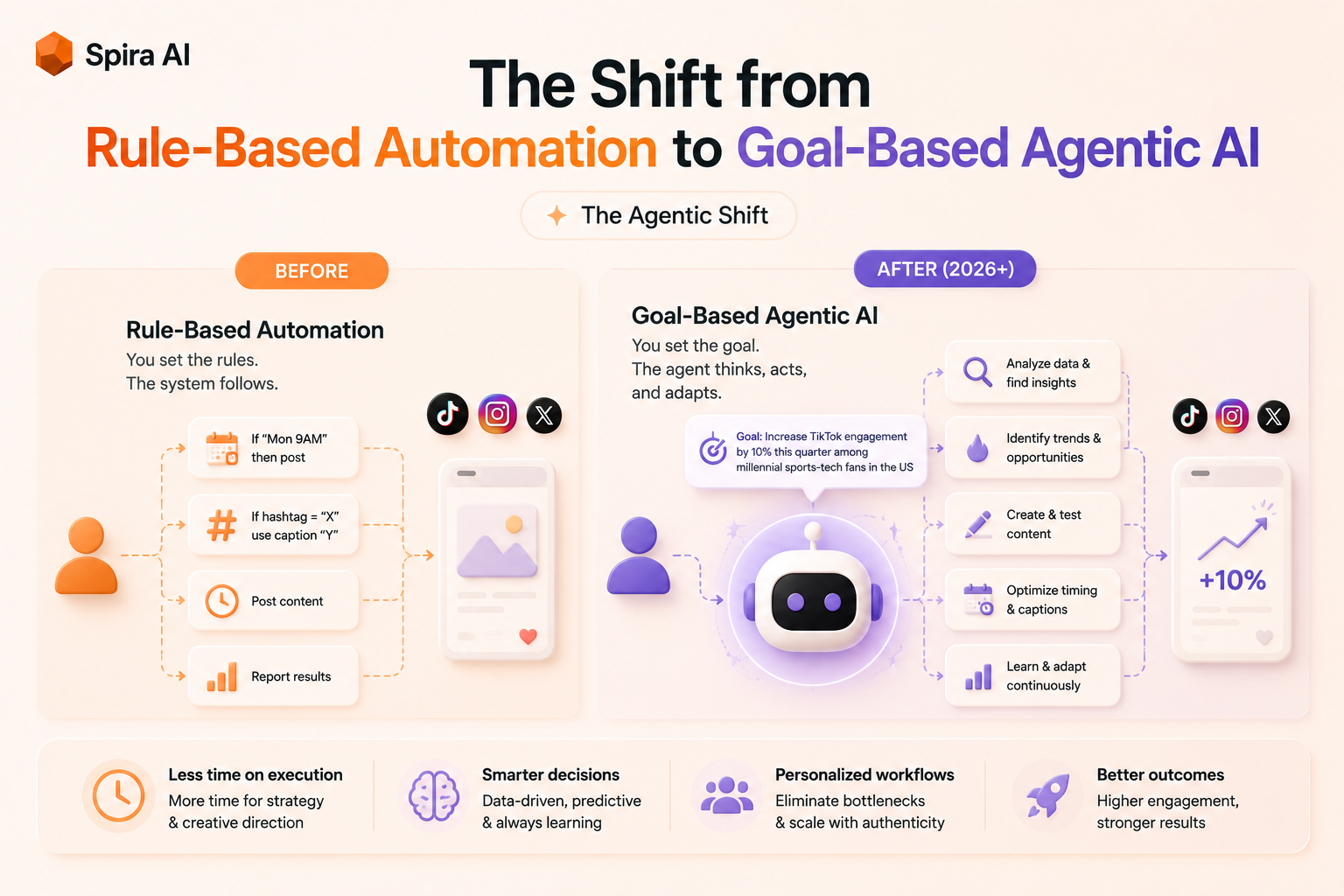
This agent will then analyze historical data, identify trending topics and content, create and publish content, test posting windows and caption strength, and adjust strategy based on performance.
For marketers, brands, and social media teams, this changes the job title and description completely. Everyone will spend less time on execution (finding competitor data, analyzing performance data, creating and publishing posts) and more time orchestrating AI agents and brand strategy. It gives more room and time for creative direction and opportunities to test it out. The brands and marketers that win will be those that effectively use AI to handle content volume, create personalized workflows that eliminate bottlenecks, and give strong direction on brand strategy for its right customers with authenticity.
About the author
Long is the founder of Spira AI. He previously worked on creative and content products at Meta, ByteDance, and Creatify. He writes about AI, social media automation, and how brands scale content without scaling headcount.
More posts by Long